A grounded way to use crystals
Crystals can be meaningful ritual objects, decorative pieces, gifts, or physical reminders of an intention. There is no good scientific evidence that crystals emit healing energy, cleanse emotions, regulate the nervous system, treat anxiety, or change external outcomes. Still, a stone can be personally useful when it helps you pause, focus your attention, breathe, journal, or follow through on a practical choice.
Think of a crystal as a symbolic tool rather than a source of supernatural power. Its value may come from its appearance, texture, personal story, or the routine you build around it. Used this way, crystals can support reflection without replacing medical care, therapy, medication, problem-solving, or evidence-based mental health support.
Do crystals have energy?
Crystals unquestionably have material properties. Different minerals vary in hardness, color, structure, density, light reflection, and chemical composition. Those physical characteristics do not demonstrate that a crystal sends out healing, emotional, protective, or relationship-changing energy.
There is no reliable evidence that crystals directly improve health, remove negative feelings, heal trauma, attract money, protect a person from harm, or alter another person’s behavior. When someone feels calmer while holding a stone, the experience may be connected to expectation, sensory attention, a familiar routine, a quiet moment, or the meaning they have chosen to attach to the object.
That does not make the experience fake or unimportant. A comforting object can help create a transition between a busy day and a more intentional moment. The grounded distinction is simple: appreciate the ritual and its effect on your choices, without making medical or supernatural promises about the stone itself.
How crystals can work as ritual and reflection tools
Rituals work best when they are clear, manageable, and connected to real life. Instead of asking a crystal to “fix” an emotion, use it as a cue for a specific practice. This approach gives your ritual a purpose you can observe: a few slower breaths, a boundary you communicate, a journal entry you complete, or a habit you return to.
Intention setting
Choose one plain-language intention, such as “I will take a real lunch break” or “I will answer honestly when I need space.” Place the stone where that intention needs to be remembered.
Journaling anchor
Keep a crystal beside a notebook to mark reflection time. Its role is to signal, “I am taking five minutes to check in with myself now.”
Habit cue
Carry a smooth stone in a pocket or bag. When you notice it, link the moment to one repeatable action: relax your shoulders, drink water, or review your priorities.
Personal symbolism
A stone can represent a season, a memory, a value, or a promise to yourself. The association is personal; it does not need to be universally true to matter.
Popular crystals and traditional symbolic associations
Crystal meanings vary across sellers, communities, and spiritual traditions. The associations below are traditions and personal interpretations, not established facts or guaranteed outcomes. Choose a stone because its symbolism feels relevant, its appearance appeals to you, or it fits the ritual you want to create.
Four practical crystal rituals
A ritual does not need special language, rare stones, or a perfect atmosphere. Keep the action small enough that you can repeat it. The following examples use crystals as prompts for reflection, not as tools for controlling health, luck, or other people.
1. The morning intention ritual
- Choose one stone and place it near your coffee, keys, or work materials.
- Write one intention that describes a behavior, not a wish for a guaranteed result.
- Examples include “I will ask one clarifying question” or “I will take a ten-minute walk.”
- Touch or notice the stone before beginning your day, then take the first practical step.
2. The five-minute journaling ritual
- Set a timer for five minutes and place a crystal beside your notebook.
- Ask: “What am I feeling?” “What do I need?” and “What is one kind next step?”
- Write without trying to make the answer impressive, spiritual, or positive.
- End by choosing one action, such as sending a message, resting, planning, or saying no.
3. The pocket pause ritual
- Carry a sturdy, smooth stone in a pouch rather than loose with keys or coins.
- When you feel rushed, hold it and notice its weight, temperature, and texture.
- Take three unhurried breaths and identify where your body is tense.
- Choose your next action deliberately instead of treating the stone as a cure for stress.
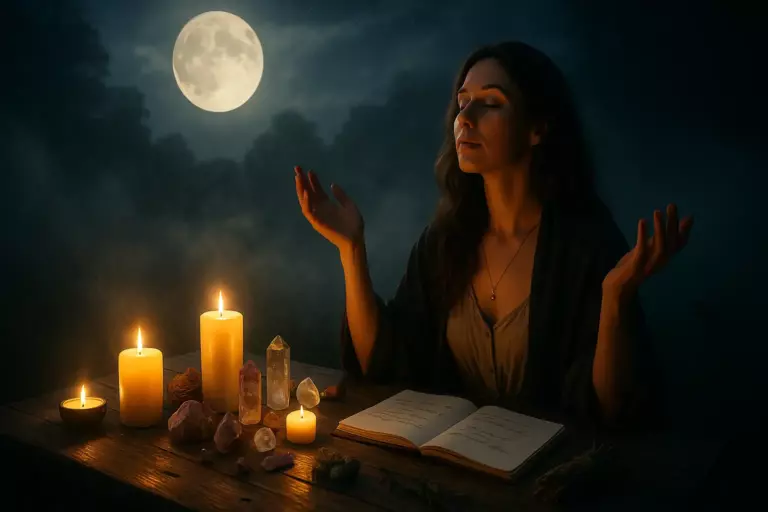
4. The monthly Moon reflection ritual
- Set aside quiet time near a new moon, full moon, or any date you will remember.
- Review what changed during the previous month, including what felt difficult and what helped.
- Choose one intention and one realistic action for the month ahead.
- Place the crystal somewhere visible, then revisit the intention during your next check-in.
If lunar symbolism helps you create a dependable review practice, see Moon rituals for a grounded monthly framework. You can also explore zodiac crystal guides as symbolic inspiration, rather than as a rulebook about your personality or future.
Meditation, décor, gifts, and daily reminders
Not every crystal practice needs to look like a formal ritual. A favorite stone on a shelf can make a room feel more personal. A polished piece on a desk can signal the beginning of focused work. A small crystal given as a gift can represent encouragement, friendship, remembrance, or a shared milestone.
For meditation, hold a stone or place it nearby as a simple object of attention. Notice the sensation in your hand, return to your breath when your mind wanders, and avoid judging whether you are doing it correctly. The stone is useful because it is concrete and easy to notice, not because it has proven power over your mind.
You can pair a crystal with affirmations if that format feels supportive. Keep affirmations believable and action-oriented. “I can take one step at a time” is often more useful than a statement that demands certainty or promises a dramatic transformation.
What cleansing and charging can mean
In many crystal practices, “cleansing” means removing unwanted energy and “charging” means restoring power. A grounded interpretation is less complicated: cleansing can be a symbolic reset, while charging can be a moment to reconnect an object with a chosen goal.
You do not need to believe that a crystal stores negative emotion. If a stone now reminds you of a stressful time, you might safely wipe it, move it to a new location, update the note beside it, or use a short sound, breath, or candle-free ritual to mark a fresh start.
To “charge” a crystal, write an intention in plain language, choose one action that supports it, and decide where the stone will serve as a reminder. Moonlight or sunlight may be meaningful parts of a personal ritual, but they do not add measurable healing or spiritual energy.
Crystal care and safety basics
Before cleaning or displaying a crystal, identify what it actually is. Some stones are soft, porous, treated, dyed, water-sensitive, or prone to fading in direct sunlight. A polished surface does not mean a stone is safe to soak, heat, wear against skin, or place in drinking water.
- Ask the seller for the mineral name, treatment information, origin, and recommended care.
- When uncertain, choose a dry method: gentle dusting, a soft cloth, or safe storage.
- Keep care instructions with the item, especially for jewelry or delicate specimens.
- Store pieces separately so they do not strike, chip, or scratch one another.
- Keep small stones away from children and pets because they can be choking hazards.
- Do not grind crystals or inhale mineral dust.
- Do not ingest crystals, make crystal elixirs, or drink crystal-infused water.
GIA’s jewelry-care guidance notes that light, heat, chemicals, and treatments can affect gemstone care. If you cannot identify a stone, do not experiment with water, salt, direct sun, or cleaning machines. Ask a qualified jeweler or mineral specialist for advice instead.
How to choose a crystal without overbuying
Choose a crystal by appearance, texture, budget, personal association, symbolism, or ritual purpose. You may prefer a pale stone near your journal because it feels visually quiet, a dark stone near your door because it represents boundaries, or a colorful specimen simply because it brings you pleasure.
Try starting with one piece rather than building a collection around promises. A modest stone you use regularly is more likely to become a meaningful reminder than an expensive item purchased under pressure. If ethical sourcing matters to you, ask where the material came from and whether the seller can describe its supply chain honestly.
Be especially cautious when a seller says a particular stone is essential for wealth, romance, fertility, trauma recovery, protection from danger, or a medical condition. No crystal purchase should make you feel afraid, defective, spiritually unsafe, or dependent on buying another item.
Avoid expensive claims, fear-based marketing, and dependency
A healthy ritual should increase your sense of agency, not reduce it. Be wary of claims that only a rare crystal can solve your problem, that you must repeatedly pay for cleansing, or that something bad will happen if you stop wearing a particular stone. These messages can create anxiety and pressure rather than support.
Also avoid medical claims. Crystals are not treatments for depression, anxiety disorders, trauma, sleep disorders, chronic pain, infections, hormonal conditions, or any other physical or mental health concern. If you are struggling, reach out to an appropriately qualified clinician, emergency service, trusted person, or local support resource.
A crystal can still be part of a coping routine. For example, it may remind you to use a grounding exercise, attend therapy, take prescribed medication as directed, or step outside for fresh air. For practical support during emotional overload, visit Grounding during emotional overload.
What crystals cannot do
Crystals cannot diagnose illness, replace professional care, guarantee a relationship outcome, make another person change, predict the future, erase grief, or create financial security. They cannot substitute for sleep, nutrition, boundaries, communication, safety planning, treatment, or time.
They also cannot carry the entire weight of your emotional life. If you notice that you feel unable to cope without a crystal, ritual, reader, or purchase, treat that feeling with compassion and consider adding more reliable forms of support. A meaningful object should be optional, not an obligation.
If you are exploring identity, values, or a more nurturing relationship with yourself, you may also find Reconnect with feminine energy helpful. The goal is not to become dependent on a symbol; it is to use symbols in ways that support your own awareness and choices.
Try a simple beginner practice
Pick one stone, one intention, and one practical action. Put the stone somewhere visible for a week, then notice whether the reminder helped you follow through.
Frequently asked questions
Do crystals really work?
There is no reliable evidence that crystals directly heal physical or emotional conditions. They can work as meaningful reminders, sensory objects, or ritual cues that support reflective habits.
Can crystals help anxiety?
Crystals are not a treatment for anxiety. You can use one as a reminder to breathe, pause, ground yourself, or use a coping skill, but seek professional support when anxiety is persistent, severe, or disruptive.
Do I need to cleanse my crystals?
No. Spiritual cleansing is optional and symbolic. Clean a crystal only when it needs safe physical care, using mineral-specific guidance rather than a generic ritual method.
Can I charge crystals under the Moon?
You can place a crystal under moonlight as part of a personal ritual. Moonlight is not known to add measurable healing energy, but the practice may help mark a monthly reflection.
Can I use several crystals at once?
Yes, if you enjoy them. There is no evidence-based need to combine certain stones, arrange them in a specific pattern, or own a complete set.
How do I know which crystal is right for me?
Choose one that you like looking at or holding, that fits your budget, and that supports a personal intention. You do not need a specialist to tell you what you must buy.
Can I put crystals in water?
Do not assume that water is safe. Some minerals can dissolve, crack, rust, release unwanted substances, or be damaged by soaking. Verify care for the specific mineral before using water.
Are crystal elixirs safe to drink?
No. Do not drink crystal-infused water or ingest mineral material. Unknown stones, treatments, residues, and mineral components can create avoidable health risks.
A simple conclusion
Crystals can be beautiful, comforting, and useful when you treat them as symbolic companions to a real practice. Choose a stone you genuinely like, connect it with one clear intention, and pair it with an action you can take today. The meaningful energy in the ritual is your attention, your values, and your willingness to care for yourself in practical ways.